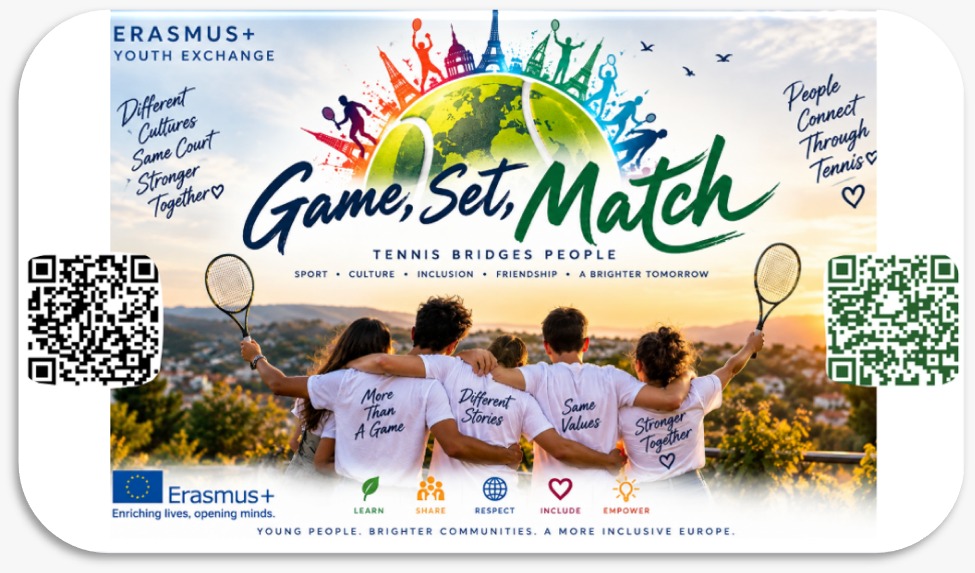
GAME,SET,MATCH
Young people today are growing up in an environment increasingly shaped by sedentary lifestyles, extensive use of digital technologies, limited opportunities for meaningful physical activity, and fewer spaces for face-to-face social and intercultural interaction. These challenges can affect not only their physical well-being, but also their motivation, social connections, self-confidence and opportunities to develop practical life skills.
The idea for “Game, Set, Match: Empowering Youth Through Tennis” was therefore not developed solely on assumptions. Before designing the project, we carried out a needs analysis involving 123 respondents in order to better understand young people’s attitudes towards physical activity, digital habits, sport, personal development and international youth activities.
The results clearly supported the relevance of the project. 67.5% of respondents stated that they would like to be more physically active, while 80.5% believed that sport improves their health and energy levels. At the same time, 58.5% felt that they spend more time than necessary online or in digital environments. Around 90% recognised that sport can develop skills beyond physical fitness. Most importantly for the design of this Youth Exchange, 82.1% expressed interest in participating in an international youth project combining sport, learning and intercultural exchange.
The needs analysis also identified practical barriers preventing young people from becoming more active, including lack of time, school or work responsibilities, financial limitations, limited local opportunities, lack of motivation and social factors. These findings showed us that simply encouraging young people to “do more sport” would not be sufficient. They need an accessible, motivating and socially engaging environment in which physical activity is connected with learning, cooperation and meaningful interaction with peers.
For this reason, we chose tennis not only as a sport, but also as a non-formal learning tool. Tennis provides opportunities to experience concentration, self-discipline, perseverance, decision-making, emotional control, fair play and respect. Through adapted tennis activities, participants with different levels of sporting experience can learn together without the project becoming a competitive sports programme. No previous tennis experience will be required.
The project will combine tennis-based activities with non-formal education methods, teamwork, reflection, intercultural learning and participant-led activities. The tennis court will become a learning space where young people can communicate, cooperate, make decisions, manage challenges and learn from one another. In this way, physical activity becomes a gateway to broader personal, social and intercultural development.
Based on the identified needs, the project has the following objectives:
To promote more active and healthy lifestyles by motivating young people to participate in accessible and enjoyable physical activities and by raising awareness of the importance of balancing digital habits with active lifestyles.
To develop personal and social competences through tennis and non-formal learning, particularly self-confidence, self-discipline, perseverance, communication, cooperation, decision-making, emotional control and fair play.
To create meaningful face-to-face interaction among young people from different countries and backgrounds, enabling them to learn with and from one another through sport, teamwork and shared experiences.
To strengthen intercultural learning and mutual understanding by creating a safe environment in which participants can discover different cultures, challenge stereotypes and develop respect for diversity.
To support inclusion and equal participation by using adapted and beginner-friendly tennis activities and non-formal education methods that allow young people with different abilities, experiences and social backgrounds to participate actively.
To empower young people to become active contributors rather than passive participants by involving them in selected activities, peer learning, reflection, decision-making and the dissemination of project results.
Ultimately, “Game, Set, Match” aims to respond to the needs identified by young people themselves: the need to be more physically active, to spend meaningful time away from screens, to develop useful life skills, to connect with peers and to experience international and intercultural learning. By bringing together sport, non-formal education and intercultural exchange, the project seeks to demonstrate that a tennis court can be much more than a place to play a game: it can become a space for learning, inclusion, participation and personal growth.